SEO won't save you in 2026: how creators win the AI search era with GEO
Zero-click search is now the default. Here is what that means for creators, and how to get found when almost nobody clicks through anymore.
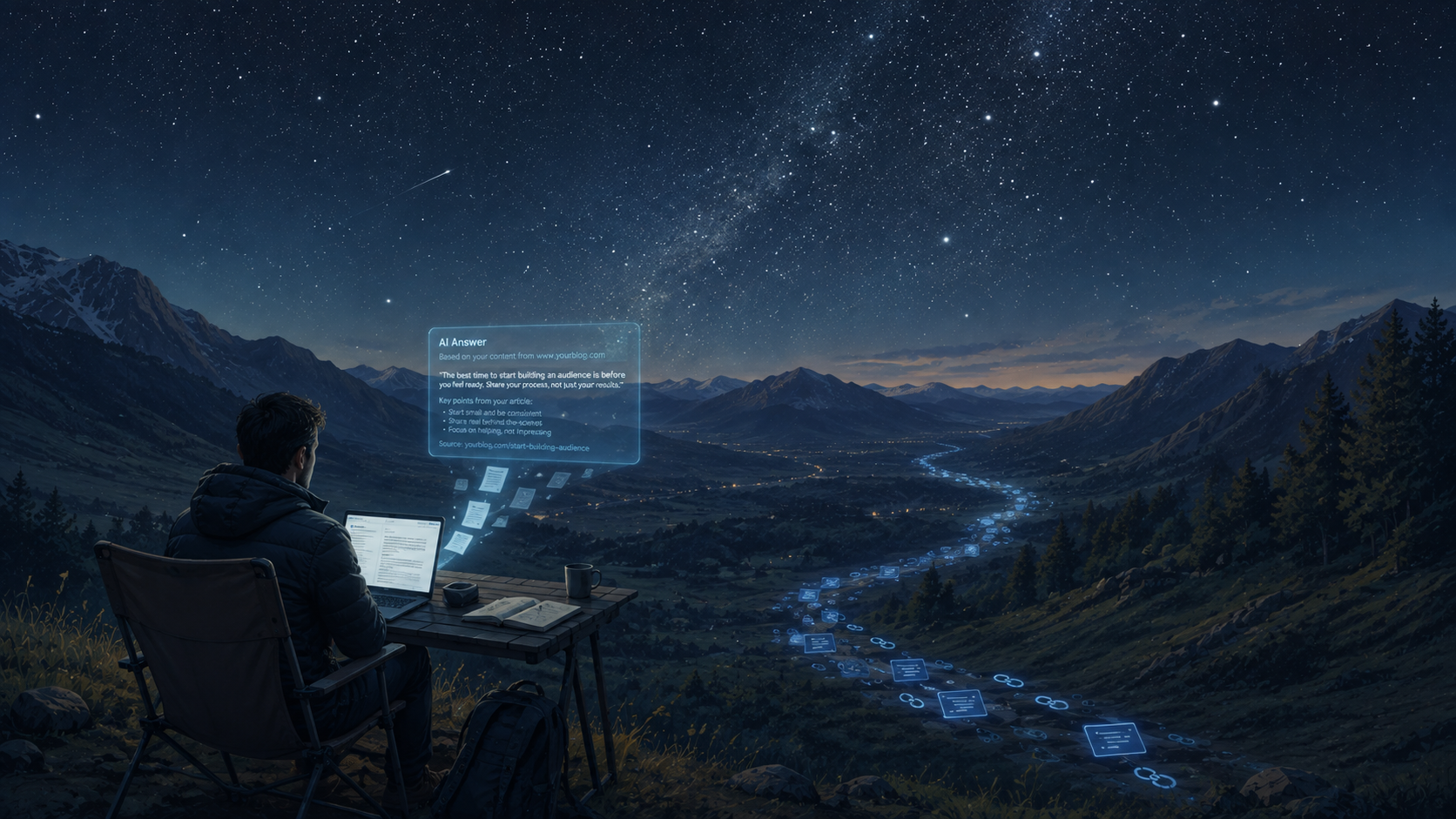
For fifteen years, the advice was simple: write good content, target the right keywords, rank on page one, and the clicks will come. That deal is now quietly breaking. Anecdotally, we don't have to look far for a real-world example. HubSpot, one of content marketing's original poster children for organic-driven growth, saw its blog's organic traffic fall from roughly 13.5 million monthly visits to under 2 million in less than a year.
The broader data confirms this isn't an isolated case. In the first four months of 2026, 68% of Google searches in the US ended without a single click, according to research from SparkToro, up from 60.45% just two years earlier. When an AI Overview appears on a search result, which now happens on more than one in five searches, click-through rates to the actual websites drop by nearly 60%. People are still searching, but they are just not landing on your page anymore. They are getting their answer from Google's AI Overviews, ChatGPT, Claude, or Perplexity, and moving on.
If your entire growth plan depended on someone clicking a blue link, that plan is standing on ground that is disappearing under it. Note: the traffic did not vanish, it just migrated into the answer itself. And that changes almost everything about how a creator should think about discovery.
Ranking #1 doesn't mean what it used to
Here is the part most creators and businesses have not caught up to yet. Being the top organic result used to be the whole game. It is far less decisive now.
Research on AI Overview citations found that 83% of the pages AI systems cite come from outside Google's organic top 10. The AI is not simply reading down the ranked list and summarizing the winner, it is now pulling from whichever page answers the question most directly, most completely, and most recently, regardless of where that page sits in traditional rankings.
Huge if true, and true it is, and that's genuinely good news for creators who have been told for years that they need a six-figure SEO budget to compete. Ranking well still helps, but it is no longer the only door in. A smaller creator with a sharper, more specific answer can get cited by an AI system ahead of a much bigger site that only has a vague, generic version of the same information. This is the same dynamic behind why small creators are winning the internet: specificity beats scale, and that is now true in AI search too.
What actually gets your content cited
Generative Engine Optimization, or GEO, is the emerging discipline of writing so that AI systems choose to quote you. It shares some DNA with SEO, but the signals that matter are different, and the data on what works is becoming clear.
Content that includes real numbers and statistics sees a 41% jump in AI visibility, since language models are drawn to concrete, checkable claims over vague generalities. Longer, more thorough pages get cited far more often than short ones too: pages over 20,000 characters earn 4.3x more citations than pages under 500, because AI systems are trying to synthesize a complete answer and reward the source that already did the synthesis. Freshness matters enormously as well. Pages updated in the last 30 days earn roughly 3.2x more citations than stale ones, and 76.4% of ChatGPT's most-cited pages had been refreshed within the last month, which means a post you wrote once in 2023 and never touched again is quietly losing its seat at the table.
Perhaps the most counterintuitive finding is about authority. Backlinks, the currency of old SEO, correlate weakly with AI visibility, at just 0.218. Brand mentions, meaning your name or your work being referenced in text even without a link, correlate roughly three times more strongly, at 0.664. Being talked about matters more than being linked to. And a striking 82% of what AI systems cite comes from earned coverage rather than anything paid or owned. In other words, the same thing that has always built a durable audience, being useful enough that other people talk about you unprompted, is exactly what AI search now rewards. That trust is the real asset, and it turns out to be a machine-readable one too.
The traffic that does click through is worth more
Here is the number that should get every creator's attention: visitors who arrive from ChatGPT convert at roughly 15.9%, compared to 1.76% for traditional organic search, nearly a ninefold difference. Separate data shows AI-referred visitors making up a sliver of total traffic, often well under 1%, while still accounting for over 12% of signups.
This makes sense once you think about what an AI referral actually represents. Someone who clicks through from an AI Overview or a ChatGPT answer has already had their question mostly answered. They are not browsing. They already trust the source enough to want more, which is a much later stage in the decision than a cold organic click. Fewer people are arriving this way, but the ones who do are closer to ready. That lines up with something worth remembering about growth: most creators fail at monetization not because they lack an audience, but because they mismatch their offer to where someone actually is in the trust curve. AI referrals are arriving further along that curve than almost any other channel.
Why creators have an actual edge here
There is a reason this shift favors individual creators over faceless content farms, and it is not a coincidence.
AI models are trained to prefer specific, experience-backed answers over generic ones, largely because that is what users actually rate as helpful. A page that says "in my experience, this took four months and cost more than I expected" tends to outperform a page that says "results may vary." That is a direct extension of something already true about AI as a creative multiplier rather than a replacement: the model can summarize information, but it still needs someone who actually lived through the thing to produce the raw material worth summarizing. A creator writing from real, specific, first-person experience is naturally producing exactly the kind of content GEO rewards. A content mill producing average, keyword-stuffed filler is naturally producing exactly what it penalizes.
The gap between "technically ranks" and "actually gets cited" is where a creator's real, lived point of view becomes a competitive advantage instead of a nice-to-have.
A practical way to think about it
You do not need to abandon SEO, in fact, this very blog post still optimizes for it. But you need to add a second target next to it: write so that an AI system could lift your paragraph directly into its answer and have it stand on its own: bring your experience, write it yourself (only get AI to check it later!), and most importantly, do not be vague.
Answer the actual question in the first two or three sentences, before any preamble, since 44.2% of what gets quoted comes from a page's opening third. Back your claims with real numbers wherever you have them: your own results, a specific timeframe, an actual price, rather than vague reassurance. Go deeper than feels necessary; short, thin posts are getting outcompeted by pages that treat a topic exhaustively. Revisit and update your best pieces on a rolling basis instead of publishing once and moving on, since freshness is now a ranking signal in its own right. And keep doing the unglamorous work of building your presence in the places your audience already gathers, because earned mentions of your name are doing more for your AI visibility than any backlink campaign could.
None of this replaces the fundamentals. It just adds a new, faster feedback loop on top of the same creator flywheel that has always rewarded consistency and a genuine point of view.
Where the traffic should land
Only 40.6% of marketers have actually implemented GEO despite 92% saying they plan to, which means most of your competitors are still writing purely for a search era that is already fading. That gap is your opportunity: seize it, but remember that you can only seize it if you have somewhere solid for that higher-intent traffic to land once it arrives.
An AI-referred visitor converting at 15.9% is a wasted opportunity if they click through to a broken checkout, a mismatched brand, or a next step that is not obvious. This is exactly the kind of moment that punishes a fragmented setup and rewards selling digital products from a single, seamless home base. The visitor showed up already convinced. Your job is just to not get in the way.
Sherpo gives you that home base: one site, one dashboard, your brand, where the trust you have built anywhere, including inside an AI answer, can turn into a course sale, a membership, or a coaching booking without a single extra step of friction.
Ready to make sure your traffic has somewhere great to land? Get started with Sherpo and turn every visitor, however they found you, into a customer.

Giacomo Di Pinto
Aug 17, 2026
7m reading time
Read more articles